A stress test. A European integrator buys a humanoid manufactured in a non-European country, slaps its logo on it, and deploys it on an aeronautics or defense production line. The robot is cheaper, it looks compliant. It maps the facilities, records production rhythms, learns the operators' gestures, films the workstations. This production data represents some of a country's most sensitive industrial secrets. And it flows through servers whose architecture and destination no one in Europe controls. The European integrator has no access to the source code. Neither does the manufacturer.
And it's not just industry. The same scenario plays out in healthcare: a rebranded exoskeleton, deployed in a French hospital, sending the neurological data of stroke patients back to Shenzhen. Or in nuclear, logistics, pharma. Everywhere a robot learns, it collects. And everywhere it collects, the question is: who receives?
This is not science fiction. China, for example, already represents more than 80% of the global humanoid market. Unitree has announced 5,500 units. Agibot has delivered 5,168. These robots are arriving in Europe through European distribution channels, with competitive prices and flexible standards.
This observation should keep us up at night.
We've seen this film before
China is a major industrial power, technologically far beyond the low-cost image some Europeans still have of it. With electric vehicles, we allowed China to build a massive industrial lead. Colossal state subsidies, economies of scale, then a flood onto the European market before we had time to react. With solar panels, same story. With batteries, same story. Are we going to watch the train pass by again?
The real issue: who controls the robot's intelligence?
A humanoid robot is not a passive tool. It is a machine that learns, accumulates data, and continuously improves. Whoever controls the embedded AI model controls the robot. And whoever controls the robot controls the data.
In a hospital, that data is medical. In a factory, it is industrial. In both cases, it is strategic. A robot whose brain is designed outside our borders and whose data passes through the same servers is not a production tool. It is a Trojan horse.
Humanoids are not meant to be exported as neutral tools. They carry a software ecosystem, AI models, cloud infrastructure, and terms of use governed by the law of their country of origin. The day an executive order decides that certain models are no longer exported to certain uses or certain countries, you are left exposed. We learned that with semiconductors. We learned it with the cloud. We saw it with the extraterritoriality of American law over our companies. If the brain of your robots is American, your robot is American. You are an integrator, not an innovator.
A third European industrial path
No one criticizes the United States for protecting its industrial interests. No one criticizes China for building its own champions. Europe has every right to do exactly the same.
Because the real choice is not between Beijing and Washington. The real choice is between being a customer and being an architect. Buying robots whose brain and data we do not control, or building a sector where embedded intelligence, data ownership, and industrial partnerships are ours. A sovereign industrial model, open to alliances with those who share our standards.
Concretely, this means building on three pillars. One: software sovereignty — European AI models embedded in European robots, with data that stays on our soil. Two: industrial alliances between technological peers — not subcontracting, but co-development with those who have the best components in the world. Three: a domestic market that favors sovereign solutions in strategic sectors — healthcare, defense, energy, aeronautics. A real industrial policy does not stop at the market's doorstep, and that is exactly what the Americans are doing with the CHIPS Act and the Chinese with Made in China 2025.
France holds the cards
What many do not know is that France today has all the ingredients to build this third path, as the architect of an intelligent alliance.
The sovereign brain first. France has Mistral, which develops some of the world's best-performing language and vision models, in open source or sovereign access. It has world-class physical AI laboratories: CEA-List, INRIA, LAAS-CNRS. The France 2030 program has deployed €10 billion for the AI ecosystem. We have the third-largest pool of AI researchers in the world.
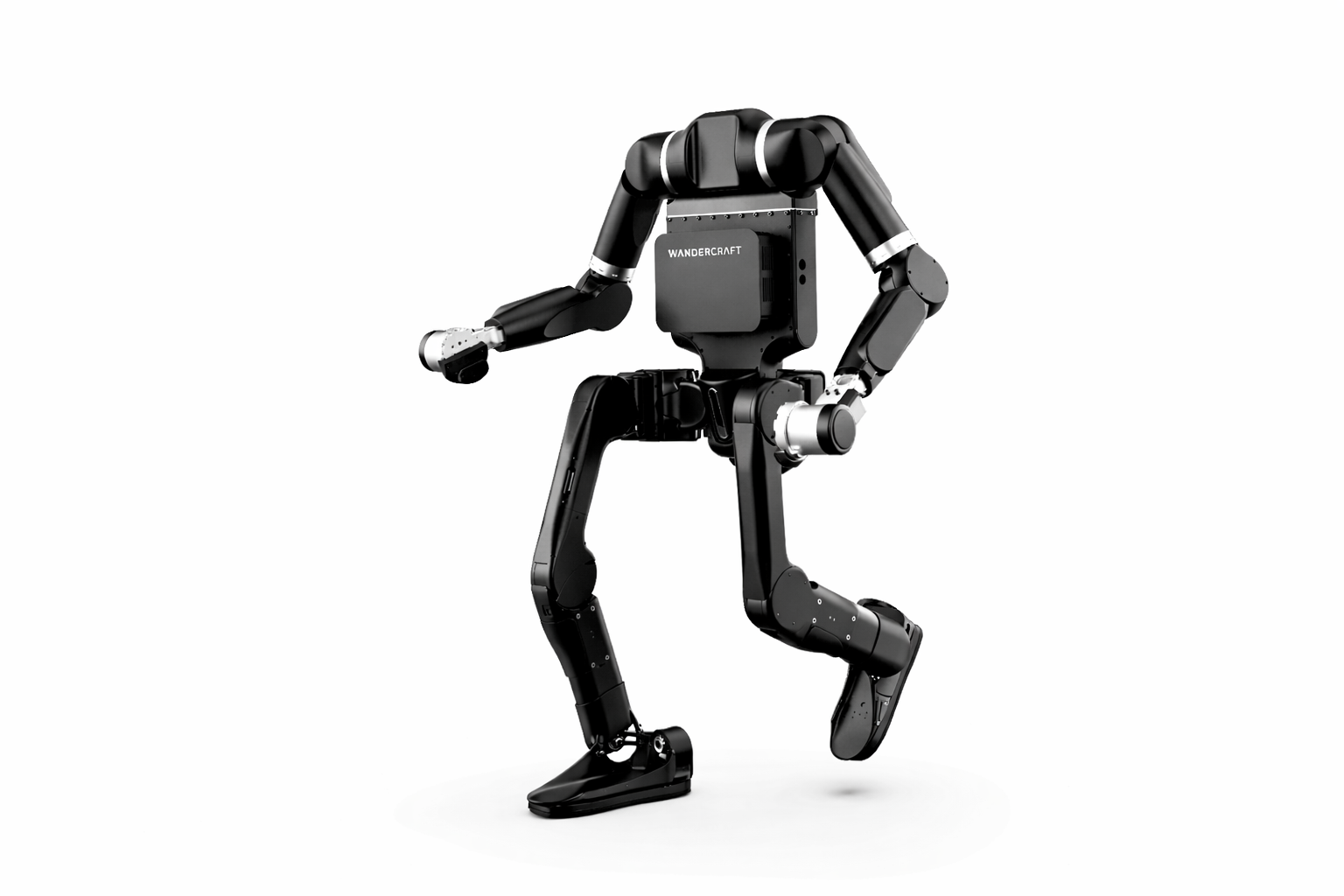
The body next. France has Wandercraft, the only European company to have mastered dynamic bipedal walking, validated on thousands of patients in clinical settings over 12 years. This is physical AI: forces, torques, contacts with the real world. This expertise in bipedal locomotion deployed in real life, with an extremely high and validated safety standard, no one else in Europe has it. The reliability of a robot that never falls, deployed on industrial production lines, its ability to carry the heaviest loads in the world for a humanoid gives us an incomparable strength to consolidate and rebuild powerful industries on our soil.
What we lack, however, are precision components for our strategic independence.
Japan, a natural partner
James Riney, an American investor based in Tokyo, recently published a clear-sighted analysis: in the race for humanoids, Japan controls how the robot's "body" works — its muscles, its nerves. Japanese companies Nabtesco, Harmonic Drive, and Sumitomo dominate more than 60% of the global precision reducer market. Keyence dominates industrial sensors. Sony produces 53% of global CMOS image sensors. Proterial has solved the dependence on Chinese rare earths through grain boundary diffusion. Japan does not make the final robot, but without Japan, no robot functions beyond 10,000 hours. This is Riney's "10,000-hour cliff": the moment when Chinese components fail and Japanese components hold.
Japan is also the world's fastest-aging country: 36 million people over 65, a shortfall of 570,000 caregivers by 2040. Its Moonshot program is investing heavily in assistive robots. METI has budgeted ¥32 billion for the mass production of humanoids. The market is there, the components are there, the demographic urgency is there.
And France and Japan have had a scientific and technological framework agreement since 1974 — 50 years of cooperation, 12 joint CNRS-JST laboratories in Japan. A joint ANR-JST call on cutting-edge AI. The rails already exist.
Kyōsei: an alliance between equals
The Japanese have a word for what we are proposing: kyōsei (共生). The creative coexistence between organisms that mutually reinforce each other. A technological symbiosis between peers.
On one side, world-class European physical AI. Sovereign models: Mistral for VLMs, French laboratories for locomotion AI, Wandercraft for data accumulated in real-world conditions. An end-to-end European AI stack and data that stays in Europe.
On the other, unmatched Japanese precision engineering. Co-developing reducers optimized for bipedal locomotion, securing the supply of critical components through direct industrial partnerships with Japanese champions. Two disciplines, the same level of excellence, a shared ambition.
Japan has every reason to engage: faced with China driving prices down and copying its technologies, Japanese manufacturers need European partners who value reliability and quality.
The urgency is now
The building blocks are there. The partners are there. Only one thing is missing: the political courage to choose and to invest massively in an alternative before it is too late.
Europe must choose a path of productive power and creation. It is often seen abroad as a player in standards, regulation, and after-the-fact responses. Let us choose to build our future rather than endure it. To be a powerful, humanist actor, serving the most vulnerable, while also capable of being at the heart of global competition. We, as industrial actors, are ready.
Ekso Bionics joins Wandercraft, uniting two pioneers to advance and expand robotic mobility
Read the announcement