By Matthieu Masselin, Co-Founder and CEO of Wandercraft
The humanoids industry is asking a useful question: how human should a humanoid be?
A recent article arguing that form should follow function moves the conversation in the right direction. At Wandercraft, we largely agree with that thesis. But our experience deploying robots next to people every day leads us to a more grounded conclusion.
Let’s start with common ground.
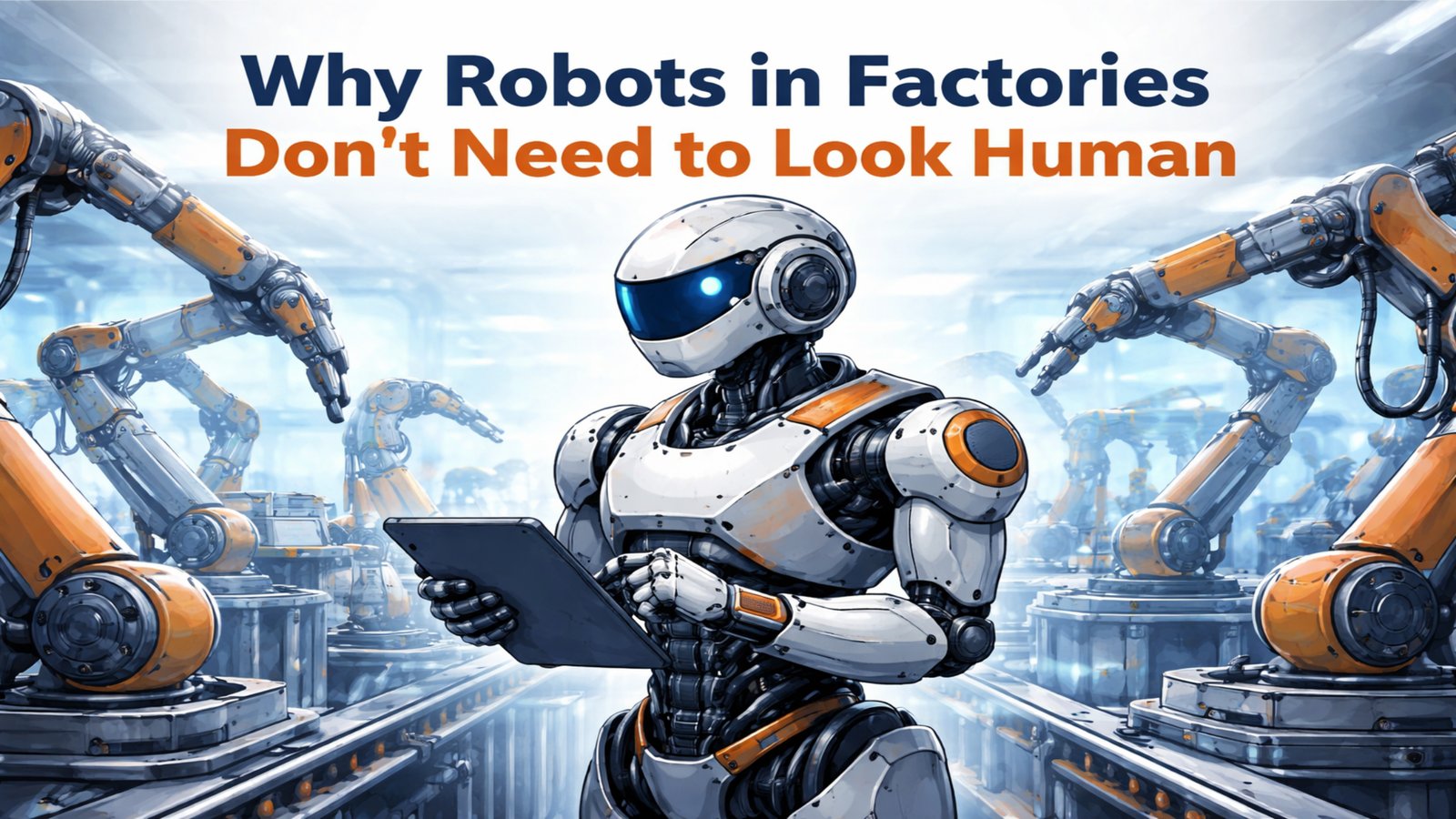
Humanoids do not need to look human to be effective. Mimicry is not a prerequisite for capability. In many cases, it is a distraction. When we’re boots on the ground at Renault, plant directors want a robot that meets human productivity standards reliably and safely- no less, no more. That’s why we started out with no head, ultimately deciding to keep it that way. Adding a head didn’t do anything for our perception capabilities or our performance but increased design cost and complexity, and actually risks introducing friction in the adoption process - more on that later.
We also agree on bipedalism, but for practical reasons.
Factories, warehouses, and worksites are built for legs. Stairs, thresholds, uneven ground, and tight spaces are everywhere. In fact, in a plant, the closer you get to final assembly, the less space you have by design. Legs are not an aesthetic choice; they are an interface with human infrastructure. For us, “humanoid” starts with being bipedal, not with resembling a person.
Where we diverge from much of the current discussion is on social acceptability.
In industrial settings, robots do not operate in isolation. They share space with workers. As a factory manager was telling me: ‘the more human a robot looks, the more discomfort it can create.’ Faces, eyes, and expressive cues raise expectations and unease. A clearly non-human robot, by contrast, is often easier to accept. It is understood as a tool, not a surrogate. Removing anthropomorphic features reduces psychological friction and accelerates adoption.
Of course, in the robotics community today, head and hands signal intelligence. I’ll start by reminding everyone that our humanoid robot has vision. In fact, we were made fun of for our initial design in that regard, with the camera located at lower abdomen level. The robot’s eyes now lie in a more palatable location, in between its shoulders. We’re also actively working on end effectors and manipulatiom capabilities for our next version of the product.
Our conclusion is simple: humanoid should not mean human-like. It should mean human-compatible.
If the industry wants humanoids to move beyond demos and pilots, we need to stop optimizing for appearance and start optimizing for deployment. Fewer questions about faces. More focus on reliability, safety, and working alongside people without friction.
This way of thinking isn’t unique to robotics. In AI, some of the most impactful systems deliberately moved away from imitation and toward capability. Interestingly, the Mistral team made similar choices by prioritizing performance and real-world use over mimicry for its own sake. The lesson is the same: systems earn trust not by resembling humans, but by working reliably in human environments.
That’s the path we’ve chosen at Wandercraft. And it’s the conversation we believe the humanoids industry needs to have next.
Ekso Bionics joins Wandercraft, uniting two pioneers to advance and expand robotic mobility
Read the announcement