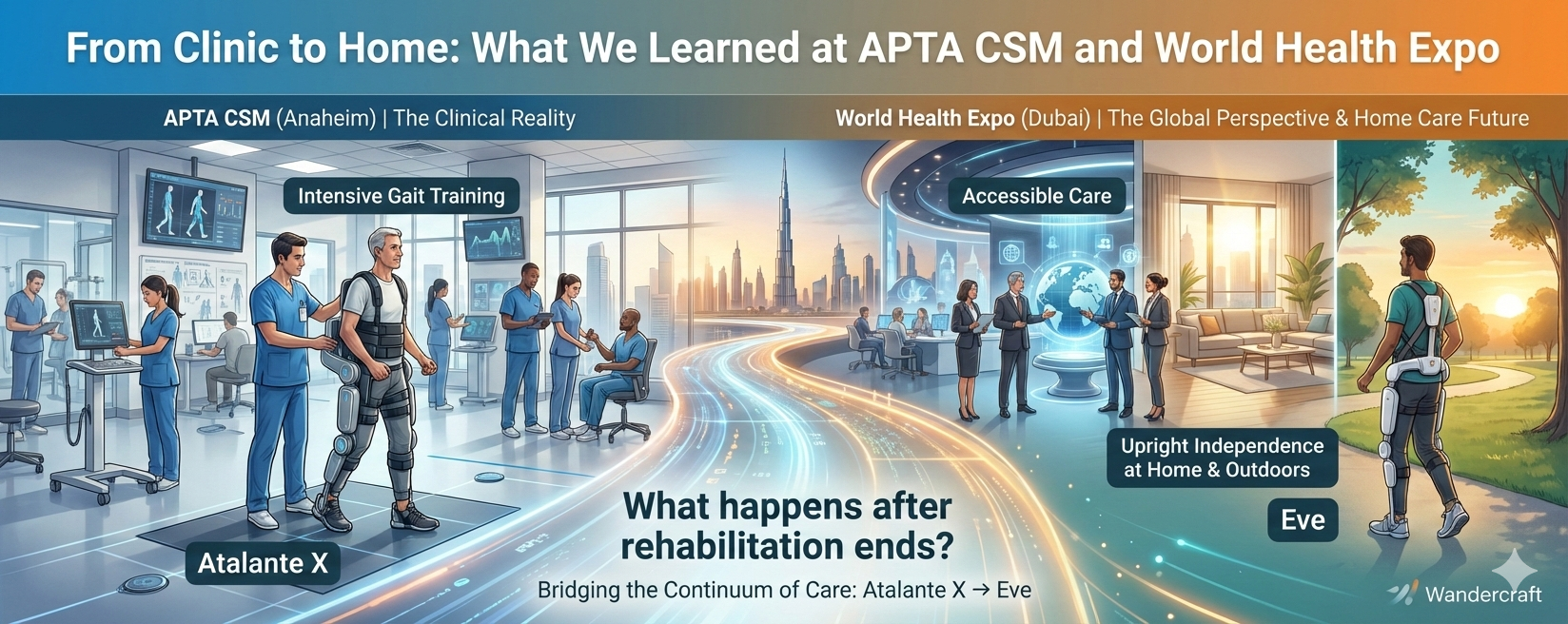
FromClinic to Home: What We Learned at APTA CSM and World Health Expo
Two weeks.Two continents. Two major gatherings that asked the same fundamental question:What happens after rehabilitation ends?
InFebruary, we brought Atalante X and Eve to APTA CSM in Anaheim, where over15,000 physical therapy professionals gathered to explore the latest inclinical rehabilitation. Days later, our team traveled to Dubai for the WorldHealth Expo, where healthcare decision-makers from around the world discussedthe future of accessible care.
At bothevents, the conversations went beyond technology specs and clinical protocols.Clinicians, researchers, hospital executives, and healthcare decision-makersall wanted to understand the same thing: how do we support patients not justduring rehabilitation, but in the months and years that follow?
This is whywe brought both devices to both events.
APTACSM: The Clinical Reality
The APTACombined Sections Meeting is the largest physical therapy conference in theUnited States, and this year's gathering in Anaheim reinforced why therehabilitation community is ready for change.
At booth647, the questions came fast: How do we manage increasing patient loads withlimited staff? How do we deliver high-quality gait training when therapists arestretched thin? How do we demonstrate measurable outcomes to administrators whocontrol budgets?
But beneaththese operational challenges was a deeper question: How do we prepare patientsfor life after they leave our care?
AtalanteX: Transforming In-Hospital Rehabilitation
Atalante Xis now deployed in over 100 rehabilitation and research centers across fourcontinents, supporting patients as they take over 1 million steps per month intherapy sessions. The system's hands-free, self-balancing design allowspatients to practice upright walking without crutches or walkers, reducing thephysical burden on therapists while enabling more intensive, task-specifictraining.
Physicaltherapists at APTA CSM recognized this immediately. One clinician told us she'dbeen waiting for this technology for a decade. Another described how Atalante Xhad changed her approach to gait training entirely, allowing her to focus onmovement quality and patient cueing rather than managing stability.
Withexpanded FDA clearance and CE-mark certification for a broader range ofneurological conditions including stroke, spinal cord injury, and multiplesclerosis, Atalante X continues to demonstrate its clinical value in real-worldrehabilitation settings.
Eve:Building the Bridge to Home
Butclinical recovery is only part of the story.
We alsoshowcased Eve, our self-balancing personal exoskeleton designed for use at homeand outdoors. Eve represents the next chapter: upright independence beyond thewalls of the rehabilitation center.
Currentlyin clinical trials in the United States, Eve builds on the same AI-poweredtechnology behind Atalante X and extends it into daily life. The goal is not toreplace wheelchairs or diminish their value, but to offer people the choice tostand, walk, and engage with their environment in ways that matter to them.
Physicaltherapists understood this distinction immediately. Many asked how they couldsupport patients transitioning from Atalante X in the clinic to Eve at home.Others wanted to know how to become part of the referral pathway, recognizingthat their role doesn't end at discharge.
Theconversation shifted from "Can they walk in therapy?" to "Whathappens when therapy ends?"
WorldHealth Expo: The Global Perspective
Days afterAPTA CSM, our team was in Dubai for the World Health Expo, where theconversation expanded from clinical practice to global health policy.
The WorldHealth Expo brings together healthcare decision-makers, hospital executives,researchers, and institutional leaders from around the world to address themost pressing challenges in healthcare delivery and access.
Here, thequestions were different but equally urgent: How do we make advancedrehabilitation technology accessible beyond wealthy countries? How do weintegrate robotics into healthcare systems that are already under-resourced?What does equitable access to mobility technology actually look like?
BeyondTechnology: The Systemic Challenge
What becameclear in Dubai is that the barriers to widespread adoption are no longerprimarily technical. The technology works. Patients benefit. Clinicians wantit.
The realchallenges are systemic: reimbursement models that don't yet account forrobotic rehabilitation, training infrastructure that needs to scale alongsidedeployment, clinical protocols that must be adapted for different healthcareenvironments, and policy frameworks that can support innovation while ensuringsafety and access.
BothAtalante X and Eve were critical to these discussions.
Atalante Xrepresents a proven clinical solution that is already scaling globally. Everepresents the future: technology designed from the ground up to be accessible,usable at home, and integrated into daily life.
Healthcaredecision-makers wanted to understand how both devices fit into the continuum ofcare. How do we support someone from acute injury through intensiverehabilitation and into long-term community living? How do we build systemsthat don't abandon patients once they leave the hospital?
These arenot easy questions, and they require collaboration across borders, sectors, anddisciplines.
TheContinuum of Care: From Clinic to Home to Outdoors
Whatconnects the conversations in Anaheim and Dubai is a shared recognition thatrehabilitation cannot end at discharge.
Fordecades, the model has been straightforward: patients receive intensive therapyin a clinical setting, then return home with a wheelchair and perhaps someoutpatient follow-up. The assumption was that walking recovery had a definedendpoint, and if patients didn't achieve independent ambulation during theirrehabilitation stay, they wouldn't walk again.
But thatmodel is changing.
Atalante Xhas shown that intensive, task-specific gait training can produce meaningfulimprovements even in patients with severe impairments. Clinical studies havedemonstrated improvements in walking speed, balance, postural control, andindependence, often accompanied by reduced pain, reduced spasticity, andincreased muscle strength.
Eve takesthis further by asking: What if walking practice didn't have to stop whenrehabilitation ended? What if patients could continue standing, walking, andmoving upright in their own homes and outdoors?
This is notabout replacing wheelchairs. Many wheelchair users live full, independentlives, and mobility devices are essential tools that provide freedom andautonomy. Rather, this is about offering choice. The choice to stand at eyelevel with loved ones. The choice to walk outdoors in the park. The choice tomove through the world in different ways depending on context and preference.
Real-WorldImpact
The numberstell part of the story. Atalante X is now used in over 100 centers worldwide.Patients have taken over 1 million steps per month in therapy sessions. Eve isadvancing through clinical trials in the United States, with commercial launchanticipated later this year.
But themore important story is the one told by clinicians and patients: the physicaltherapist who can now treat patients she previously couldn't help, therehabilitation director who saw his facility's outcomes improve, the patientwho stood at his daughter's wedding.
This iswhat happens when technology meets real need.
What'sNext
The workahead is clear. Clinical adoption must continue to expand. Policy frameworksneed to evolve to support new models of care. Pricing and reimbursementstructures must make this technology accessible to those who need it most.
Wandercraft'smission has always been about more than building robots. It's about restoringupright independence, supporting clinicians, and reimagining what's possible inrehabilitation and beyond.
Theconversations at APTA CSM and the World Health Expo showed us that therehabilitation community, the healthcare system, and patients themselves areready for this shift.
Now we haveto deliver.
LearnMore
Atalante Xis available in rehabilitation centers worldwide and continues to expand accessthrough regulatory clearances in the United States, Europe, and beyond.
Eve iscurrently in clinical trials in the United States, with commercial launchanticipated later this year.
Ready tolearn more about how Atalante X can support your rehabilitation facility, orhow Eve is pioneering upright independence at home and outdoors?
Contact our team:
For moreinformation about our clinical trials, research partnerships, or to join thewaitlist for Eve, visit: /form
Big news is coming
Click here to know more