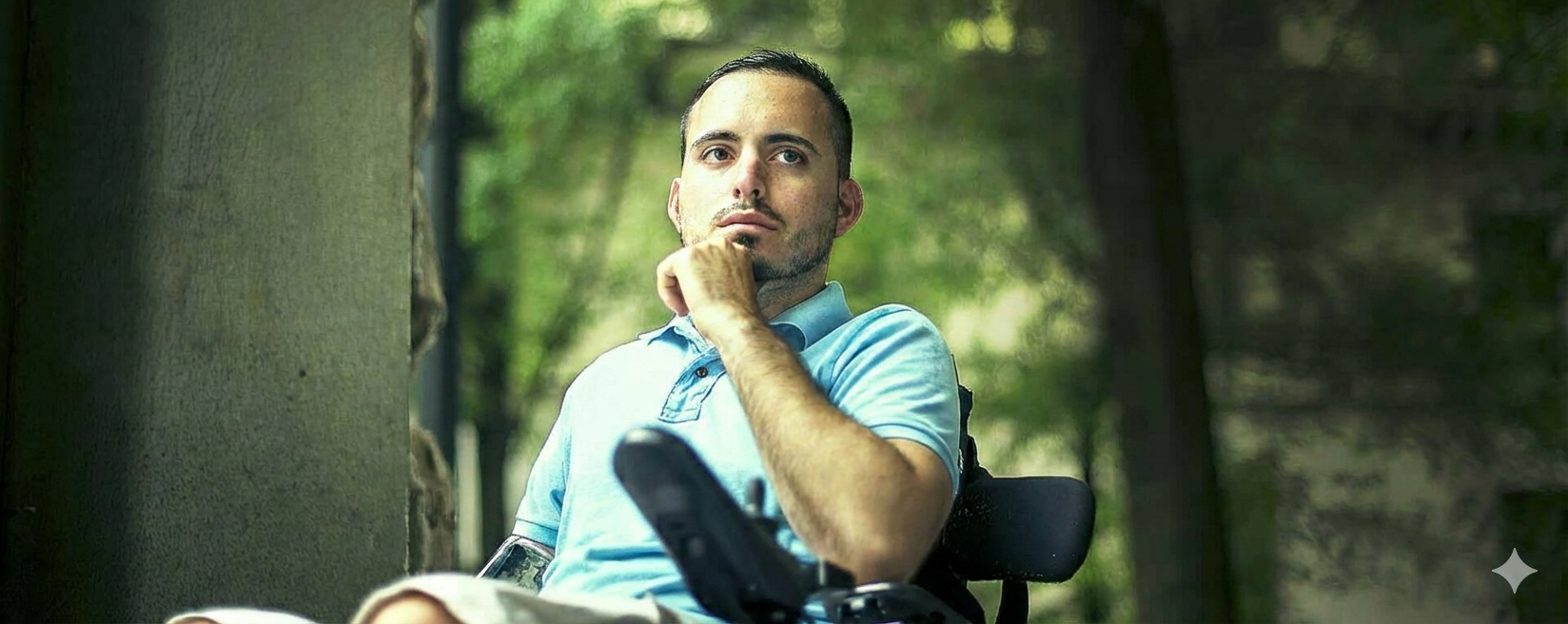
New York, NY – February 23rd, 2026 – Ignacio Montoya, a U.S. Air Force veteran and Ph.D. candidate in biomedical engineering at Georgia Tech and Emory University, shared results from a multi-year self-study showing that combining transcutaneous spinal cord stimulation (tSCS) with adaptive, task-specific training – including Atalante X™ – may help reawaken dormant neural pathways a dozen years after a clinically complete spinal cord injury. The study was presented at this year’s Society for Neuroscience annual meeting.1
Montoya sustained injuries that caused paralysis below his chest and in his dominant arm. Instead of accepting these limitations, Montoya pursued research. Working with clinicians, engineers, and neuroscientists, he became both a study participant and a contributing investigator in this clinical study.
Montoya’s body started to respond to the structured training sessions over years of effort. As robotic assistance was gradually decreased, his steps became more consistent, muscle activation improved, and he gained better control over movement, evidence of a learning process taking place within a nervous system long thought to be static. What emerged was not just improved walking mechanics, but signs that communication between the brain and spinal networks was strengthening.
“This has been a true team effort,” said Montoya. “We’ve focused on pairing neuromodulation with training that requires active participation. As robotic assistance is gradually reduced, the task becomes progressively more demanding while maintaining stability. That shift from being moved to actively engaging is where adaptation begins.”
Montoya experienced improvements in stepping consistency, muscle activation patterns, and in areas that affect everyday function. These included gains in endurance, cardiovascular conditioning, posture, bladder sensation, and bowel function. For someone living with paralysis, these changes are not just small steps but a return of control over their own body.
Atalante X is a fully self-balancing, hands-free exoskeleton designed to help people stand, walk, and relearn natural movement patterns from their very first session. By eliminating the need for walkers or crutches, it opens access to individuals with limited upper-body strength or complex neurological conditions.
“What makes Ignacio’s work so powerful is not just the science; it’s the spirit to push the boundaries of what people think is possible with technology,” said Matthieu Masselin, Wandercraft Co-Founder and CEO. “Atalante X is a tool, but it’s individuals like Ignacio, and the clinicians and researchers around him, who show us all what's possible when innovation is guided by human determination.”
1. Transcutaneous Spinal Neuromodulation Combined with Task-Specific Training Restores Sensorimotor and Autonomic Function After 12 Years of Clinically Complete SCI
About Wandercraft
Wandercraft is a global robotics company on a mission to restore mobility and expand what’s possible through self-balancing, AI-powered systems. Known for its groundbreaking Personal Exoskeleton, Eve™, Wandercraft is developing the next generation of mobility solutions to restore walking ability both at home and in rehabilitation. Its flagship device, Atalante X™, is a groundbreaking self-balancing exoskeleton used at more than 100 inpatient and outpatient rehabilitation centers.
In 2025, Wandercraft expanded into industrial robotics with the launch of Calvin-40™, a strong, autonomous humanoid robot announced in conjunction with a strategic partnership with Renault Group. Built on the same life-tested robotics platform as Wandercraft’s medical exoskeletons, Calvin is engineered to perform physically demanding or hazardous tasks in real-world environments, starting with manufacturing. With more than 30 patents and a deeply human mission, Wandercraft believes that everyone should have the chance to move freely – and that robotics should connect with people where they are, with reliability, responsiveness, and purpose. Learn more at wandercraft.eu.
Media Contact
Elodie Andriot
Global Head of Growth
elodie.andriot@wandercraft.health
Big news is coming
Click here to know more