The promise of personal exoskeletons is to make sophisticated robotics practical and accessible across rehabilitation, home, and everyday life.
By Matthieu Masselin
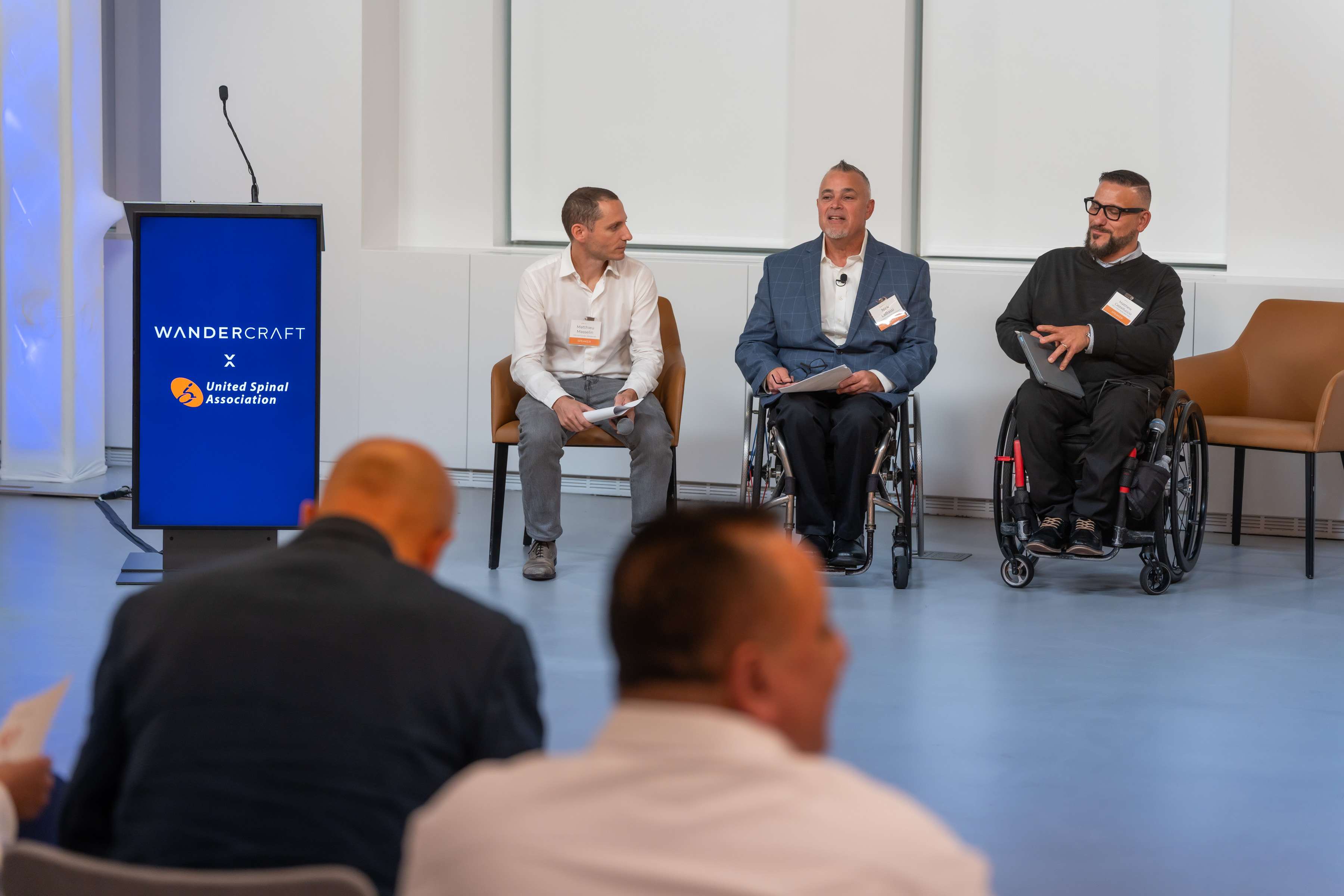
On Sept. 17, Wandercraft celebrated the U.S. commercial launch of Eve at an event in New York City, marking the personal exoskeleton's commercial availability to eligible people living with spinal cord injuries. Eve is FDA-cleared for eligible adults with spinal cord injuries at any neurological level.
Some of the program’s most revealing insights came from three Eve pilots, who shared how upright mobility had already affected their lives and what possibilities they hoped it might unlock. Their descriptions were strikingly ordinary: reaching for a plate in a kitchen cabinet, cooking a meal, having a conversation at eye level, or standing while hugging a spouse or child.
These seemingly simple moments offer a meaningful measure of progress in mobility technology. Engineering achievements, clinical research, and regulatory clearance are important, but commercial availability shifts the focus. The challenge is no longer just whether advanced mobility technology can be built, but whether people can access it, clinicians can integrate it into clinical practice, and users can make it part of everyday life.
The launch took place alongside United Spinal Association’s 80th anniversary, an appropriate pairing. United Spinal grew out of the work of paralyzed veterans who began organizing in 1946 and went on to advocate for accessible transportation, buildings, healthcare, employment, civil rights, and participation in community life.
Decades of advocacy created the environment in which technologies like Eve can now be developed and used. That history reinforces a principle that should guide mobility innovation: Who are we building this with, rather than for? Everything demonstrated that evening was made possible by those 80 years of tireless advocacy.
Technology Is Only the Starting Point
The next challenge is integrating robotics into rehabilitation and daily life in ways that make clinical and practical sense.
Dr. Thomas Bryce, medical director of Mount Sinai’s Spinal Cord Injury Program, described gait training for some people with significant lower-extremity weakness that traditionally could involve one therapist assisting each leg and another person managing an assistive device. As exoskeletons became part of therapy, he said, the technology could provide support and, in some sessions, reduce the number of therapists needed to assist with walking. Over time, exoskeleton use became part of routine therapy in his rehabilitation gym.
That raises broader questions about staffing, efficiency, therapy intensity, and how clinicians can use their time most effectively. The value of a technology may include not only what it enables a patient to do, but also how it changes the delivery of care.
Dr. Karen Nolan, associate director of the Center for Mobility and Rehabilitation Engineering at Kessler Foundation, framed the larger challenge this way: “I think we should consider looking at exoskeletons as a continuum from the beginning of the rehabilitation process all the way through to use in the community.”
Building that continuum requires more than devices. Research must reach clinicians, who need education and training. Patients need to understand their options, and payers need evidence to evaluate reimbursement and coverage. Rehabilitation medicine and physical therapy programs also need to expose future practitioners to emerging robotic technologies.
Sophie Pellas, Wandercraft’s vice president of business development, offered a reminder of how much the field has changed. Years ago, while spending time at a rehabilitation center, she recalled a rehab director telling her: “Exoskeletons do not have a place here on the gym floor. We do not want to give patients false hope that one day they can stand up and take steps. We are here to teach them how to be independent in the wheelchair when they leave the hospital.”
The concern reflected the technology’s capabilities at the time. Those capabilities have changed.
That evolution should not turn mobility into a choice between one technology and another. Crispin Teufel, CEO of National Seating & Mobility, put it succinctly: “Mobility is never one size fits all. It’s personal, it’s clinical, it’s emotional.” A wheelchair may be the right technology for one activity, while an exoskeleton may open possibilities for another. The goal is a broader toolkit matched to a person’s goals, circumstances, and environment.
Access Will Determine Impact
Commercial availability makes access more urgent. A device can move beyond research and into the market, but its impact still depends on whether people can evaluate it, obtain coverage, complete training, and get continuing support.
Medicare has established a reimbursement pathway for eligible personal exoskeleton users through its Durable Medical Equipment, Prosthetics, Orthotics, and Supplies program under HCPCS code K1007, but this does not guarantee coverage for every claim. Individual eligibility, clinical assessment, payer requirements, and coverage decisions still matter.
Access has been central to Eve’s development. Solving a difficult engineering problem is not enough. The goal is to put the technology within reach of as many eligible people as possible. Otherwise, what’s the point? Making access meaningful requires a coordinated pathway from evaluation and prescription through coverage, training, delivery, and long-term support, with rehabilitation centers, mobility providers, clinicians, payers, advocates, users, and families all playing a role.
When Technology Becomes Everyday Life
Dr. Robert Winston, spinal cord injury program director at Braintree Rehabilitation Hospital, spoke about the potential medical, emotional, vocational, and social implications of upright mobility. “Imagine standing eye to eye in conversation instead of sitting in your wheelchair,” he said.
He also described what he sees when patients stand after an injury: “I think about looking at the patient’s face the first time they stand after an injury, that look of pride, the look of confidence, the look that says, I’ve got this.” That confidence, he said, can carry into returning to work, participating in the community, and navigating everyday life at home.
The people using the technology make those implications tangible. Robert Woo, an architect, spoke about standing and talking with people at eye level rather than looking up from a wheelchair. He described wanting to cook without worrying about falling or balancing with crutches, and recalled standing after years in a wheelchair and suddenly being able to see the far end of the room again. He also described the significance of standing while hugging his wife or children.
Caroline Laubach described how upright mobility changed the way she experienced and engaged with the world around her. During her first extended experience walking in Eve, she said: “I wasn’t staring at the ground. I wasn’t worried about keeping my balance in an exoskeleton. I wasn’t worried about, you know, am I gonna fall over? It was more about connecting with the world around me and connecting with the community at large.”
She also talked about something more ordinary: wanting to feel comfortable in a kitchen again, including being able to reach cups, bowls, and plates stored beyond reach. Her broader description may say even more about what mobility can mean: “Eve has brought me back into that mindset of feeling confident in myself, in seeing myself in different spaces that I thought were erased from my life forever.”
Weston Greenwood, injured in a snowboarding accident in 2025, looked ahead to what he hopes future generations of the technology will make possible outdoors. He talked about someday being able to “go for a walk around the park” or “enjoy walking down the street, like I used to.” Those remain aspirations rather than current indications for Eve, but they illustrate where users hope mobility technology can eventually go.
Those aspirations also underscore the importance of distinguishing between where the technology may be headed and what it can safely do today. Eve is a prescription medical device. Users undergo individual assessment and training, and a trained companion must be present during use. Eve is currently intended for use on level indoor surfaces and level surfaces in immediately adjacent open-air areas that are part of a building, such as patios and terraces
Upright mobility carries risks, and continued improvements in safety, usability, access, and capability remain essential.
Progress depends on reducing the limitations while being clear about where the technology stands today. It also depends on continuing to listen. Pellas invited users and clinicians to do exactly that: “If you have suggestions, if you want to push us, please continue reaching out. Tell us the features you’d like to see in Eve tomorrow. The indications you’d like to see for your patients tomorrow…”
United Spinal CEO Matthew Castelluccio framed the larger stakes in terms of choice: “We no longer have to accept limited options for mobility, living environments, careers, and so many other aspects of our lives.”
He also made the responsibility broader than any one company, clinician, or advocacy organization: “As I look around the room, I hope all of you realize that you are part of this community and can make a difference, too.”
Commercial availability is an important threshold, but it is not the destination. The work ahead is to broaden access and make mobility technology increasingly useful where people actually live their lives. Success may ultimately look surprisingly ordinary: reaching into a cabinet, talking face-to-face, walking through a room, or embracing a family member.
It will simply feel like life.